20+ yrs
MA traffic experience behind the AI
You get a complete court binder — built for your citation, covering both hearings: how the clerk-magistrate hearing works, your word-for-word script, a full officer cross-examination for the appeal, your exhibits, and the defenses most drivers miss. Reviewed and approved by a licensed MA attorney, so it's real legal advice — not a guess.
Built only for Massachusetts citations · Every paid binder reviewed by a licensed MA attorney
That ticket isn't a one-time fine — it's a bill that keeps charging you. Here's what's actually on the line.
One "responsible" finding can raise your insurance for up to six years. That's often far more than the ticket itself — our cost calculator shows you how much.
You get 20 days from the citation date to request a hearing. One day late and you've waived the right — there's no easy do-over.
"I didn't know" doesn't move a magistrate. The right cross-examination of the officer and clean exhibits do — and almost no one shows up with them.
In Massachusetts the fine is the smallest part. The real damage lands on your insurance for years — and for some drivers, it puts the license itself at risk. Here's how the money actually stacks up.
A speeding fine in Massachusetts typically starts around $50 and climbs by a set amount for every mph over the limit. It stings once — but it's the only cost most people ever think about.
A "responsible" finding adds points under the state's Safe Driver Insurance Plan (SDIP). Those points sit between you and your insurer — and each one can push your premium up at renewal.
SDIP looks back six years. One finding doesn't just raise this year's premium — it can keep raising it, every renewal, until it finally ages off your record.
Free · takes 30 seconds · uses your real numbers
Junior operators and anyone facing a criminal citation are in a different category entirely — the license, and sometimes a record, is on the line. The free license-risk check shows you exactly where you stand, and the Enhanced binder adds a consult with the attorney whenever you want one.
For most drivers a speeding ticket is a surcharge. For some it's a suspension. Answer four quick questions and we'll tell you straight which side of that line you're on — in Massachusetts terms.
At-fault accidents and prior moving violations both count. Not sure? Estimate — the read updates as you move it.
General Massachusetts information based on your answers — not a prediction or legal advice. Suspension rules, surcharge counts, and thresholds depend on your exact record and the RMV. An attorney review is the only way to know for sure.
You get a finished draft for free. Paying turns it into an attorney-reviewed binder — which means it's actual legal advice, prepared for your citation.
Chat with our assistant or answer a short guided form — when, how fast, and how the officer measured your speed.
The AI sizes up your case from a deep Massachusetts knowledge base and shows you where you stand — your deadline, your odds, and how your defense opens. See it before you pay a cent.
Buy a binder and a licensed MA attorney reviews, corrects, and approves every page — usually within 24–48 hours (weekdays). That's the step that makes it legal advice.
You arrive with a script, officer cross-examination, and pre-marked exhibits. Add a consult and we talk it through first.
Free The instant draft is AI-generated information, not legal advice. · Paid Once an attorney reviews it, your binder is legal advice for your citation.
Most people have no idea what actually happens after they request a hearing. Here's the whole path, plainly, so nothing catches you off guard.
Follow the steps on the back of your citation to contest — online or by mail — within your 20-day window. There's a fee to request a clerk-magistrate hearing, and it has to be in on time — miss it and the finding is automatic.
~$25 hearing fee · deadline-criticalInformal, no jury. Usually the officer isn't there — a police prosecutor simply presents the ticket. Your job is to show the ticket alone isn't enough and put your account on the record. Your binder's script is built for exactly this.
Informal · officer usually absentThe magistrate decides responsible or not responsible. Not responsible and you're done — no fine, no surcharge. Responsible and the fine and SDIP points attach, unless you take the next step.
Responsible / Not responsibleFound responsible? Appeal to a judge for a fresh hearing (de novo), requested right after the magistrate's decision, with a separate fee. Now the ticketing officer must appear — and if they don't, the case is dismissed. This is where your cross-examination goes to work.
~$50 appeal fee · officer must appearThe judge's decision is generally the end of the road for a civil ticket. Further review is narrow and rare. Knowing this up front helps you put your best case forward at the magistrate hearing — not bank on later rounds that may never come.
Limited further reviewYour binder maps to every step above — how to request for step 1, your script for step 2, and the full officer cross-examination and appeal guide for steps 4–5.
No account, no payment. Answer a few questions and the AI previews your defense — your deadline, an honest read on your odds, and how your hearing script opens. The full write-up comes with your binder.
Just the basics. The citation date is the only one we need to calculate your deadline.
Check everything that's true. This is what shapes how the AI drafts your defense.
Generated from your answers — an honest read, not a promise of any outcome. This is a preview: enough to see where you stand. The full defense is built out and attorney-approved in your binder.
A licensed MA attorney reviews, corrects, and approves your binder — script, officer cross-examination, and pre-marked exhibits. That's the step that turns this draft into legal advice you can rely on.
See binder options — from $99This isn't a generic chatbot. It's trained on the law, the science, and the procedure that decide these hearings — then supervised by a licensed attorney with over 20 years at the bar.
Not a tip sheet — a complete, attorney-approved binder built for your citation. Everything a lawyer would prepare, organized for the clerk-magistrate hearing and ready for the judge's appeal.
Who's really in the room: the officer usually isn't there — a police prosecutor simply presents the ticket. You'll know exactly what you're walking into.
The back-of-the-ticket steps to contest, by mail or online — included only if you haven't filed yet.
What to say and in what order — opening by asking whether the citation is even present, because a ticket they can't produce can mean dismissal.
Heard fresh (de novo) before a judge — and if the ticketing officer doesn't appear, the case is dismissed.
Calibration, training, target identification — each question backed by the case law (Commonwealth v. Whynaught) and the exact words to say with the answer.
Your Merit Rating Board record is date-stamped. A late-recorded citation can be dismissed under the "no-fix" law (M.G.L. c. 90C §2).
Stop sign, one-way, or speed-limit signage measured against the national standard (the MUTCD) — obscured or non-conforming signs are an opening.
Turn a clean record and your real circumstances into leverage with the magistrate or judge.
Your court's address, parking, and what to bring — plus etiquette so you look prepared from the moment your name is called.
Setup and courtroom etiquette for a virtual hearing, so the tech never trips you up.
The tips and tricks that actually move cases — calm, brief, and credible beats clever every time.
A checklist for gathering your photos, dashcam, and records — with an honest read on what helps and what to hold back.
Three labeled copies of every exhibit — one for the court, one for the officer, one for you — already in the binder.
Send up to three questions straight to the reviewing attorney from your dashboard, right up to the hearing.
A ready-to-send Merit Rating Board records request and a step-by-step guide to pulling your own RMV record.
Real pages from an attorney-approved binder. This is the level of detail you walk into court with — not a tip sheet.
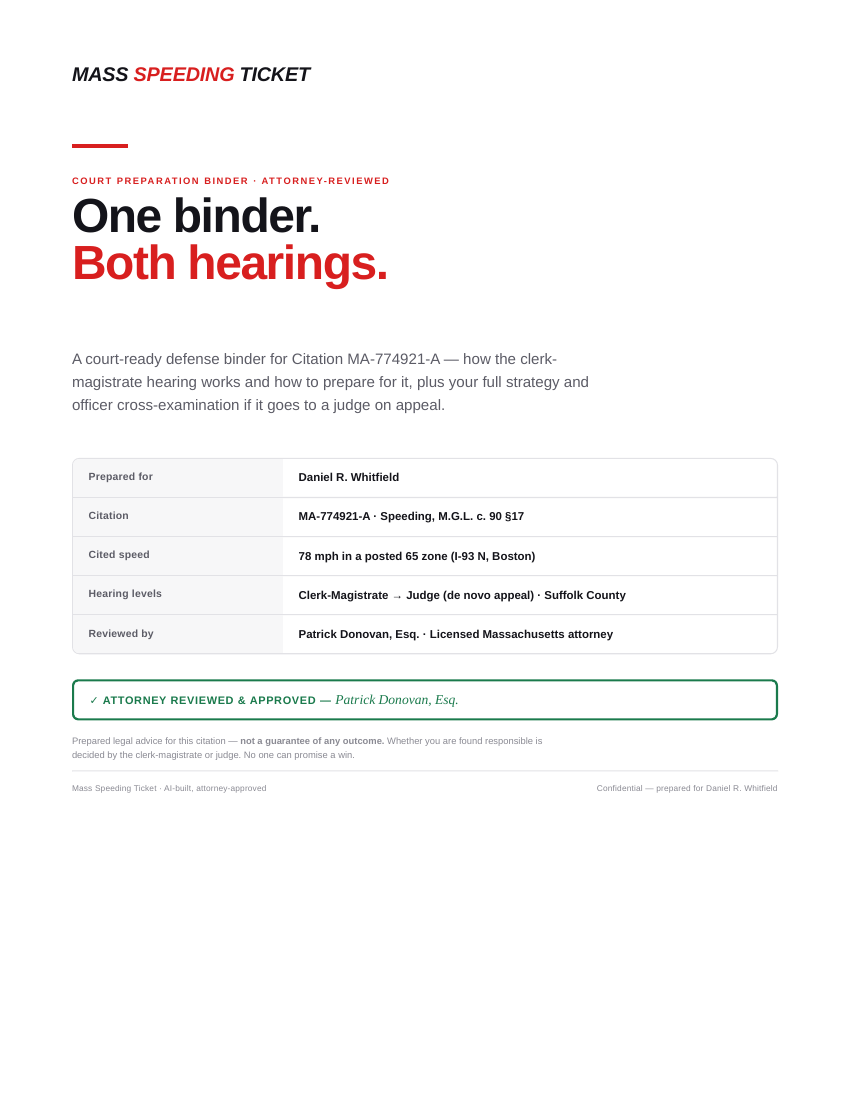
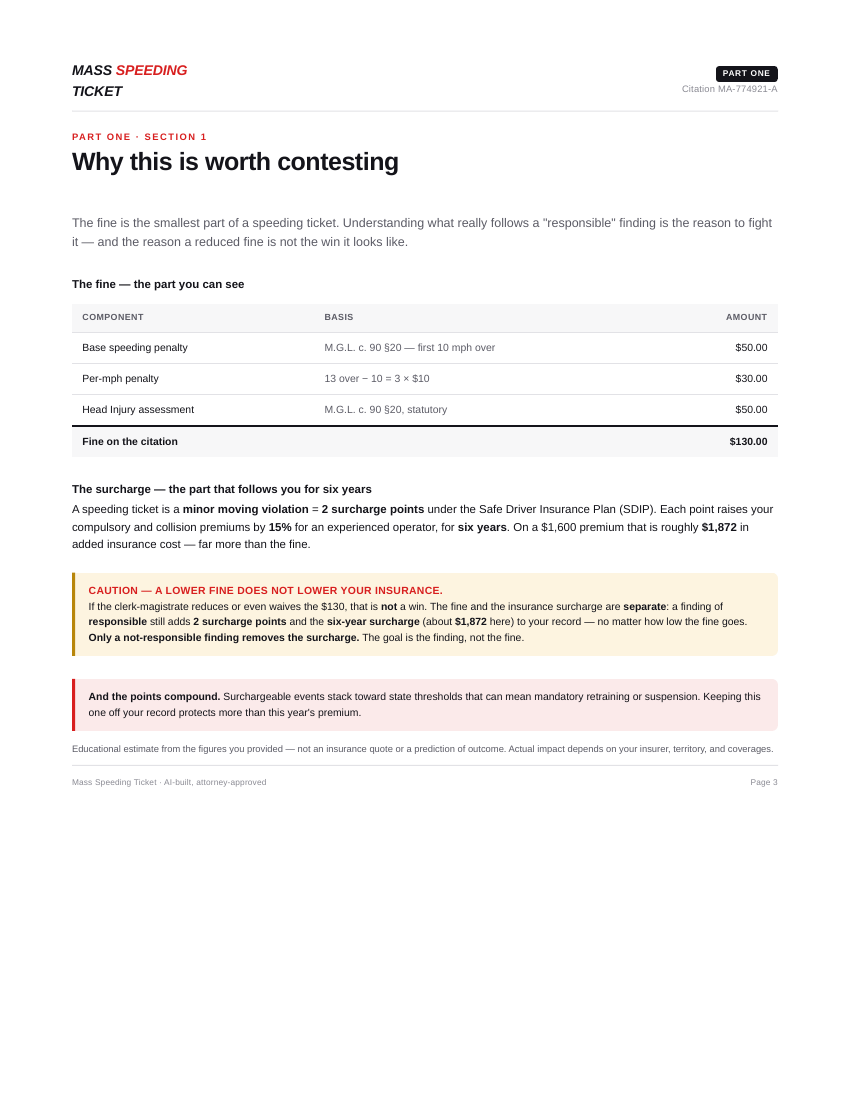
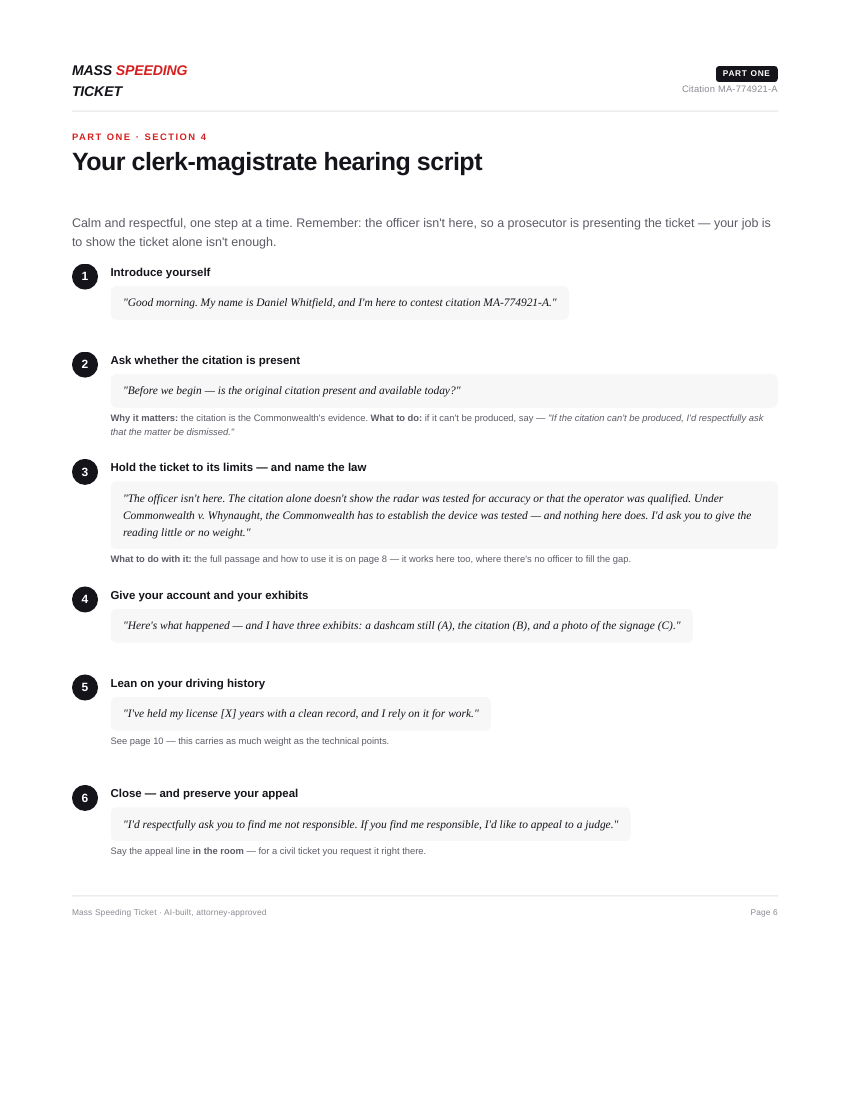
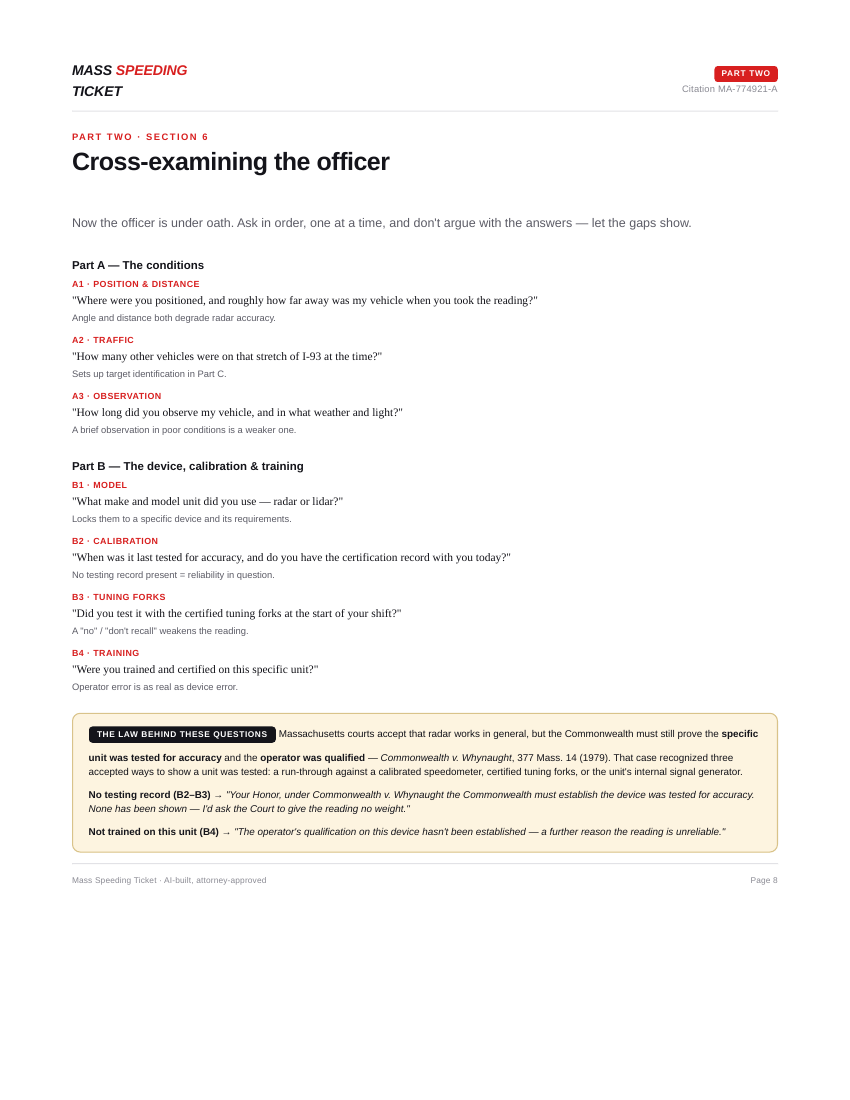
more pages — hearing-day prep, Zoom, the appeal, evidence, and hand-up-ready exhibits.
Sample binder shown for illustration. Your binder is built for your citation and reviewed by a licensed MA attorney. No outcome is guaranteed.
Drop in your photos, dashcam, and the citation itself. The AI doesn't just store it — it tells you what each piece does for your case.
For the judge's appeal, your binder hands you the questions in order — each tied to something the officer must prove, and backed by the case law. You're not arguing; you're letting the gaps show.
Pin down distance, lane, traffic, and weather — on the record — before anything technical comes up.
When was the radar/lidar last calibrated? Certified by whom? Were you trained on this exact unit?
With other cars around, how do you know the reading was mine? Each question maps to a real gap in the case.
Q 1 — Calibration
"Officer, when was the radar unit you used last calibrated, and do you have the certification record with you today?"
Q 2 — Target identification
"There were other vehicles around me. How did you confirm the reading was from my car and not another?"
Why this order
Lock in the conditions first, then the device, then the reading. If any link is missing, the judge hears it in your favor — without you ever raising your voice.
Two records tools, free with either binder. Neither is required — both can add leverage.
We write a formal request to the Massachusetts Merit Rating Board for the delivery records on your citation. If the state was late filing it, that can be grounds to challenge the surcharge.
Federal privacy law (the DPPA) means we can't pull your driving record for you. So every binder includes a step-by-step guide to getting it yourself from Mass.gov ($8 online, $20 certified by mail).
Both paid binders are reviewed and approved by a licensed MA attorney — so what you get is legal advice, not just information.
See where you stand before you spend anything.
A finished, attorney-approved defense — your legal advice.
The full binder, plus time with the attorney directly.
Secure payment through LawPay · We never store your card details
No outcome is guaranteed. We prepare you and a licensed MA attorney reviews your binder — but whether you're found responsible is decided by the clerk-magistrate or judge. We can't and don't promise a win.

Patrick has been a licensed Massachusetts attorney for over 20 years, defending drivers in traffic court. He designed the defense logic the AI runs on, and he personally reviews and approves every paid binder — so what you get isn't a template, it's legal advice grounded in how these hearings really go.
No jargon. If something's still unclear, ask Allie at the top of the page.
The free draft takes two minutes and shows you your deadline, your odds, and the start of your defense. Read it first — then decide on a binder.
Build my free draft ▸Speeding ticket, another moving violation, or an at-fault accident — answer a few questions and see exactly where you stand: what it really costs, whether your license is at risk, and how long you have to act. Then build a defense binder to take to court.
Enter your citation once and get your real cost, license-suspension risk, a live deadline countdown, and a guided hearing request with a printable court binder — including the "no-fix" defense most drivers never know they have. The fastest way to see everything at once.
Any ticket, moving violation, or at-fault accident — the fine plus the full six-year SDIP insurance surcharge. The number that should drive your decision.
Estimate the cost →Check your record against every Massachusetts automatic-suspension threshold — junior-operator rules, the 3-in-2-years and 7-in-3-years lines, and habitual-offender exposure.
Run the check →You get 20 days from the citation date to demand a hearing. Enter your date and we'll show you the exact day you must file by — miss it and the finding is automatic.
Find my deadline →A step-by-step walkthrough to demand your clerk-magistrate hearing the right way and on time — what to sign, what to pay, and where to send it.
Walk me through it →The no-fix rule (G.L. c. 90C §2) is one of the strongest defenses there is. Check whether the officer issued your citation properly and whether it has meaningful mistakes.
Run the review →A ready-to-send Merit Rating Board records request (a late-filed citation can be challenged) and a guide to pulling your own RMV driving record — both included with every binder.
See what's included →